If you’ve been watching Australia’s economy lately and feeling a strange sense of familiarity, you’re not imagining it. The mix of heavy government spending, stubborn inflation, and a central bank trying to thread the needle has a “we’ve seen this movie before” vibe.
This article isn’t about panic. It’s about pattern recognition—because in finance, the biggest mistakes often come from assuming “this time is different” without doing the comparison.
1) Which party was in government then—and now?
In 2007, Australia was governed by the Australian Labor Party (ALP) under Kevin Rudd (elected in late 2007). Today (2026), Australia is again governed by the ALP.
The point isn’t that one party “causes” a crisis. The point is that policy settings—especially spending and regulation—shape inflation, interest rates, and confidence.
2) What were their policies?
2007-era settings (pre-GFC)
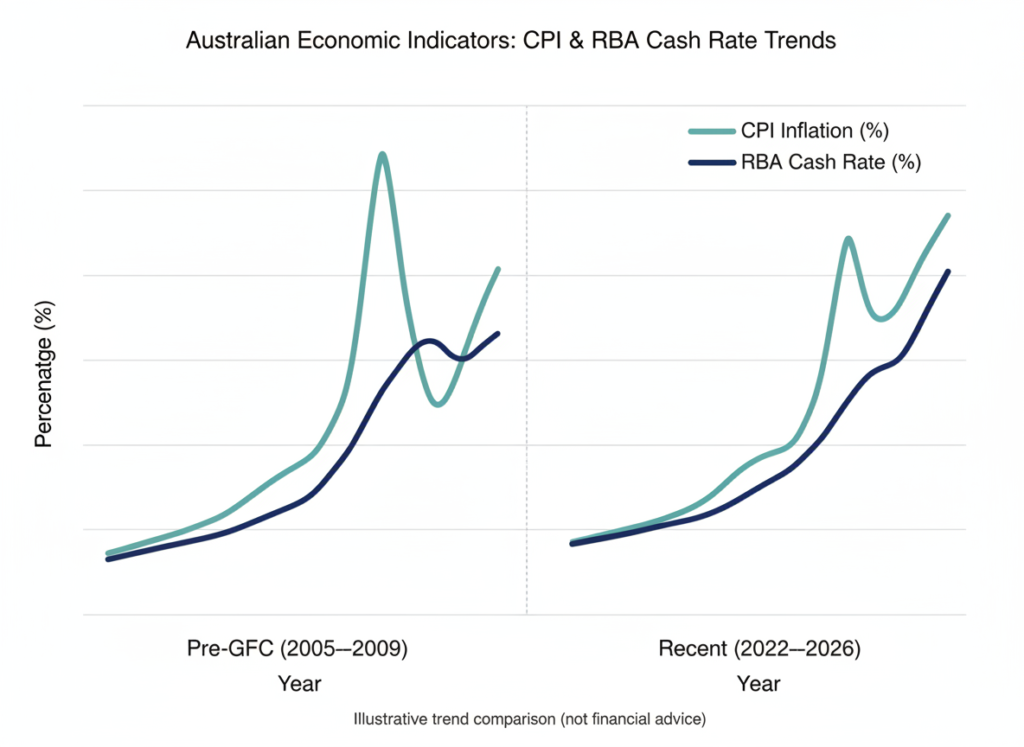
In the lead-up to the GFC, Australia benefited from a strong resources boom and rising household wealth. But the economy was also running hot.
Key themes included:
Current settings (2026)
Fast-forward to today and the themes rhyme:
The common thread: when spending (public and private) runs ahead of the economy’s ability to supply goods and services, prices rise.

3) What was the Reserve Bank doing?
Then
In the mid-2000s, the Reserve Bank of Australia (RBA) was tightening monetary policy to contain inflation. Rates were lifted as the Bank tried to cool demand without derailing growth.
Now
Today, the RBA has also been in a tightening cycle (or maintaining restrictive settings) to fight inflation. The dilemma is similar:
For brokers and borrowers, the practical reality is the same: when inflation is the problem, interest rates stay higher for longer.
4) What was the world economy doing?
Then
In 2007, the global economy looked strong on the surface:
But underneath, leverage was building—especially in the US housing and structured credit markets.
Now
The global economy today also has a “strong on the surface, fragile underneath” feel:
Different triggers, similar vulnerability: when the system is highly leveraged, shocks travel faster.
5) What happened to the financial markets?
Then
In 2007, markets went from calm to chaotic as credit risk was repriced:
Now
We’re again in a period where markets are highly sensitive to:
When confidence is fragile, markets don’t need a “big” event—just a catalyst.
6) What happened to confidence?
Confidence is the invisible engine of credit.
Then
Once people realised the risks were bigger than advertised, confidence collapsed:
Now
Confidence today is being tested by:
When households feel squeezed, they stop spending. When lenders feel uncertain, they stop approving.

7) What was the result?
In 2007–2009, the result was a global credit crunch and a sharp repricing of risk. Even where Australia avoided the worst of the recessionary impact, the lending landscape changed:
The big lesson: credit is always available—until it isn’t.
8) What’s likely to be the future?
No one can time the next crisis perfectly. But we can outline plausible scenarios.
Scenario A: “Soft landing” (best case)
Scenario B: “Higher for longer” (most likely if inflation sticks)
Scenario C: “Confidence shock” (the GFC-style risk)
This is the one that feels most like 2007:
What brokers (and borrowers) should do now
Whether or not history repeats exactly, preparation beats prediction.
Final thought
“Déjà vu” doesn’t mean we’re guaranteed a repeat of the GFC. But it does mean the ingredients—spending, inflation, tightening, and fragile confidence—are familiar.
If 2007 taught us anything, it’s that markets don’t break when everyone is scared. They break when everyone is comfortable.