
If you’ve ever wondered why central banks around the world, including the Reserve Bank of Australia (RBA), keep talking about “targeting inflation between 2% and 3%”, you’re not alone. This target isn’t based on an ancient economic law or a complex mathematical model — it’s a surprisingly modern concept born out of practical necessity.

Where Did It All Begin?
The idea of inflation targeting originated in New Zealand in the late 1980s. At the time, New Zealand was grappling with extremely high inflation, peaking above 15%. In 1988, Finance Minister Roger Douglas and newly appointed Reserve Bank Governor Dr Don Brash introduced a landmark policy change under the Reserve Bank of New Zealand Act 1989 to restore price stability.
During a TV interview, Douglas suggested a near-zero inflation goal, but to make that more realistic, the Reserve Bank implemented an initial target band of 0–2% in 1990. This was later widened to 0–3%, and eventually settled at 1–3%.
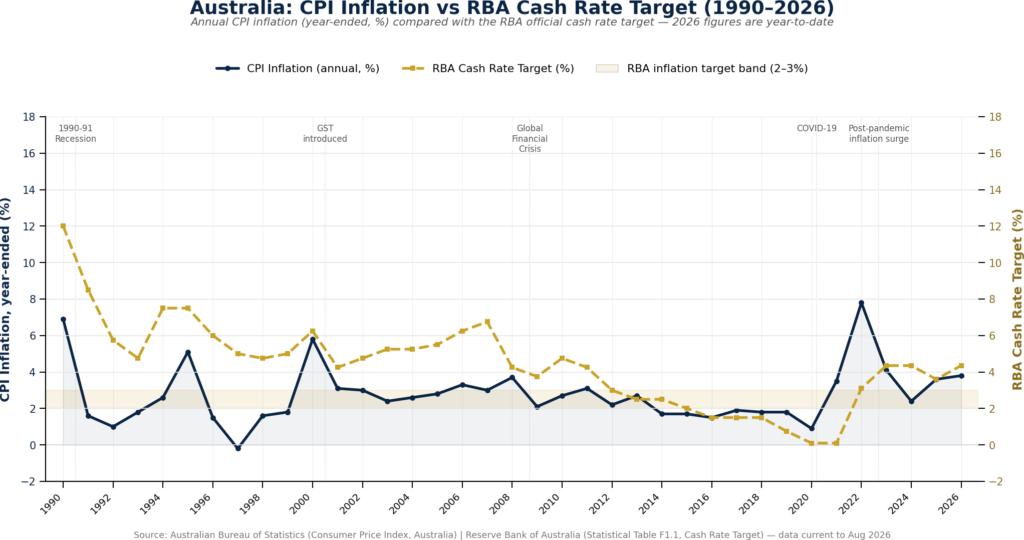
The results were immediate — and impressive. Inflation fell, economic stability improved, and before long, central banks around the world followed suit:
- Australia (1993–1996): The RBA formalised a flexible target of 2–3% on average over the business cycle, led by Governor Bernie Fraser.
- Canada & UK (1991–1992): Both adopted similar targets shortly after seeing New Zealand’s success.
- United States (2012): The Federal Reserve formally set its 2% target under Ben Bernanke.
Why Not Target 0% Inflation?
You might think zero inflation sounds ideal — money retains its value, right? In theory, yes. But in practice, aiming for 0% inflation creates more problems than it solves. Here’s why most central banks agree that 2–3% inflation is the sweet spot:
1. A Buffer Against Deflation
Deflation — falling prices — is far more dangerous than mild inflation. If prices keep dropping, people delay purchases, businesses cut costs, and economies spiral downward. A small positive inflation rate is a safety net against this scenario.
2. Flexibility to Lower Interest Rates
When economic slowdown hits, central banks cut interest rates to encourage borrowing and investment. With 0% inflation, rates hit zero too quickly (known as the “zero lower bound”). A 2–3% inflation target gives more room to manoeuvre.
3. Accounting for CPI Measurement Bias
Price indices like the CPI often overstate inflation by 0.5–1% due to things like substitution effects and quality improvements. So, a reported 2% inflation may actually reflect closer to 1% in reality.
4. Wage Stickiness
Workers hate pay cuts. Mild inflation allows real wages to adjust downward when necessary without cutting dollar amounts on paycheques — smoothing labour market flexibility.
RBA Inflation Control Challenges in Today’s Economy – Accredited Broker

Why This Matters for Mortgage Brokers and Homebuyers
At first glance, inflation targeting seems like something only economists care about. But in reality, it affects every mortgage holder in Australia.
The RBA uses this target to guide interest rates. When inflation trends above 3%, rates rise — which means higher home loan repayments. When it falls below 2%, rates often drop, making borrowing cheaper.
For homebuyers and brokers, understanding inflation’s role is crucial for timing purchases, refinancing home loans, and managing cash flow. The 2–3% target helps maintain economic stability, ensuring predictable lending conditions and better long-term planning for your clients.
Bottom Line
The 2–3% inflation target isn’t random — it’s a well-thought, globally tested policy framework balancing economic growth and price stability. And for mortgage brokers, it’s more than an economic tidbit: it’s a powerful insight influencing interest rates and borrowing costs every single day.
Frequently Asked Questions (FAQ)
Why Do Central Banks Target 2–3% Inflation?
1. What is the main purpose of targeting 2–3% inflation?
Central banks set a 2–3% inflation target to maintain economic stability. This range encourages sustainable economic growth while avoiding the risks of deflation or runaway inflation. It also provides a predictable environment for businesses and homeowners.
2. How does inflation influence mortgage interest rates in Australia?
Inflation and interest rates go hand-in-hand. When inflation rises above the target, the Reserve Bank of Australia (RBA) typically increases the cash rate, which pushes home loan interest rates higher. Conversely, if inflation falls below 2%, the RBA is likely to lower rates, reducing borrowing costs.
3. Why can’t inflation just be zero?
Aiming for 0% inflation might sound ideal, but it creates major economic risks. Zero inflation increases the chance of deflation, limits the RBA’s ability to cut interest rates in downturns, and makes wage adjustments harder during tough times. A slight positive inflation rate provides the flexibility economies need.
4. When did the RBA adopt the 2–3% target band?
The Reserve Bank of Australia adopted its inflation target policy during the early 1990s, influenced by reforms in New Zealand and other developed nations. Since then, the 2–3% target has become a cornerstone of Australian monetary policy.
5. How does the inflation target benefit everyday Australians?
Stable and predictable inflation keeps interest rates more consistent, making it easier for Australians to budget for mortgage repayments, loans, and investments. It helps protect against sudden cost-of-living spikes and supports long-term financial planning.
6. Why is understanding inflation important for mortgage brokers?
Inflation trends influence lending decisions and borrowing costs. When brokers understand what drives rate changes, they can better advise clients on fixed versus variable rates, refinancing strategies, and long-term affordability.