
For much of the past two decades, Australian investors have had an unwavering love affair with property and shares. Bonds, by comparison, have often been viewed as the quieter corner of the investment universe. Yet after one of the most aggressive global interest-rate tightening cycles in modern history, the fixed-income market may now be presenting one of its most compelling opportunities in more than a decade.
With many central banks having already begun easing monetary policy and others expected to follow, the combination of elevated bond yields and the prospect of declining interest rates is creating a potentially attractive setup for investors seeking both income and capital growth.

Understanding Bonds
At their core, bonds are simply loans made by investors to governments, banks, corporations, or other institutions.
When an investor purchases a bond, they are effectively lending money to the issuer in exchange for:
- Regular interest payments, known as coupon payments.
- The return of the principal amount when the bond reaches maturity.
For example, if an investor purchases a $100,000 government bond paying a 5% coupon, they would typically receive $5,000 per year in income until maturity, when their original $100,000 is returned.
Traditionally, bonds have been regarded as defensive investments because they generally exhibit lower volatility than shares while providing a predictable income stream.
Why Bond Prices and Interest Rates Move in Opposite Directions
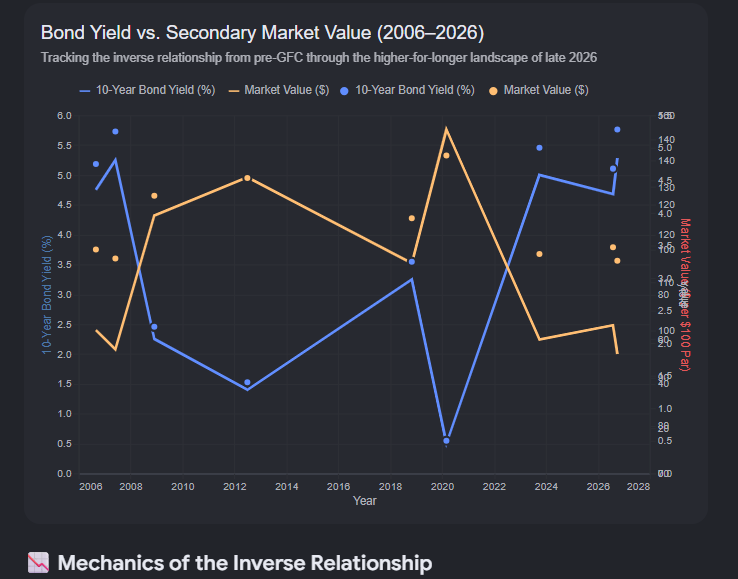
One of the most important concepts in bond investing is understanding the inverse relationship between bond prices and interest rates.
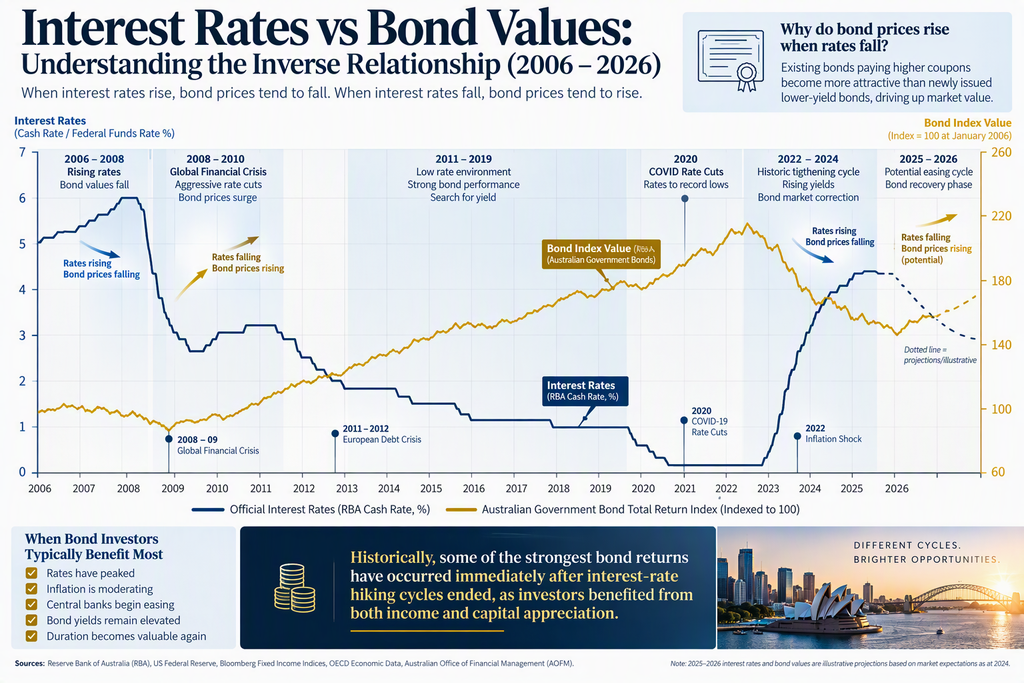
When interest rates rise, bond prices generally fall.
When interest rates fall, bond prices generally rise.
This occurs because newly issued bonds reflect prevailing market interest rates.
Imagine an investor owns a bond paying 5% interest. If newly issued bonds suddenly pay 6%, the existing bond becomes less attractive and must fall in price to compete.
Conversely, if market yields decline to 4%, that same 5% bond becomes more attractive. Investors are willing to pay a premium to secure the higher income stream, pushing the bond’s price higher.
This simple mathematical relationship underpins one of the strongest investment opportunities currently emerging in fixed-income markets.
The Recent Interest Rate Cycle Has Changed the Landscape
From 2022 onwards, central banks around the world aggressively increased interest rates to combat inflation.
The Reserve Bank of Australia, the US Federal Reserve, the Bank of England, and the European Central Bank all pushed rates significantly higher than investors had become accustomed to over the previous decade.
As interest rates rose, bond prices fell sharply.
Many bond investors experienced capital losses, leading some commentators to question whether bonds still had a place in modern portfolios.
However, those declines have now created a very different environment.
Unlike the ultra-low-rate period before the tightening cycle, many high-quality government and corporate bonds now offer yields not seen for more than a decade.
Put simply, investors today can purchase bonds with substantially higher starting income than was available during the years of near-zero interest rates.

Why Falling Rates Could Create Significant Capital Gains
The most exciting aspect of today’s bond market isn’t just the income available.
It’s the potential for capital appreciation if interest rates continue trending lower.
Consider a simplified example.
An investor purchases a 10-year bond yielding 5.5%.
If the market eventually returns to an environment where comparable bonds yield 3.5%, that higher-yielding bond becomes considerably more valuable.
Investors seeking the now-scarce 5.5% income stream may bid up its price, generating a capital gain for the original holder.
In other words, investors aren’t limited to coupon income.
They may benefit from:
- Income return from regular interest payments.
- Capital return from rising bond prices.
This dual-source return potential is one reason many institutional investors closely monitor bond markets when interest-rate cycles begin to reverse.
The Importance of Duration
Not all bonds respond equally to changing interest rates.
The key concept here is duration.
Duration measures a bond’s sensitivity to interest-rate movements.
Generally speaking:
- Short-duration bonds are less sensitive to rate changes.
- Long-duration bonds are more sensitive to rate changes.
For example, a two-year bond might experience only modest price increases when rates fall.
A 10, 20, or 30-year bond may enjoy significantly larger gains because its future cash flows are affected more dramatically by changes in discount rates.
This is precisely why some professional investors selectively increase portfolio duration when they believe a rate-cutting cycle is approaching.
Of course, the reverse is also true. Longer-duration bonds tend to experience larger declines when rates rise, making risk management and diversification essential.
History Shows Bonds Often Shine After Peak Rates
While past performance never guarantees future outcomes, historical evidence suggests bonds have frequently delivered strong returns after aggressive tightening cycles.
Following previous central-bank hiking campaigns, bond markets have often performed well as:
- Inflation moderated.
- Economic growth slowed.
- Central banks reduced policy rates.
- Investors sought defensive assets.
During such environments, bond prices generally benefited from falling yields while investors continued collecting coupon income.
The current environment shares several characteristics with previous periods where fixed-income investments produced attractive risk-adjusted returns.
How Bonds Compare with Other Investments
Cash and Term Deposits
Cash and term deposits benefit when rates rise but become less attractive when rates fall.
As banks reduce deposit rates, income earned on cash holdings declines accordingly.
A bond purchased today may lock in a higher yield for many years while potentially offering capital upside.
Shares
Equities remain essential wealth-building assets, but they can experience substantial volatility during economic uncertainty.
Bonds can help offset some of that volatility while generating regular income.
Property
Australian investors have historically favoured residential property, often viewing it as the default investment vehicle.
However, property comes with concentration risk, maintenance costs, transaction expenses, and liquidity constraints.
By contrast, bonds can provide diversification, regular income, and daily liquidity without requiring investors to manage tenants, repairs, or vacancies.
Risks Investors Should Understand
Although the outlook appears promising, bond investing is not without risk.
Inflation Risk
If inflation proves stubborn and remains elevated, central banks may keep interest rates higher for longer.
This could limit bond-price appreciation.
Interest Rate Risk
Future rate increases would generally place downward pressure on bond prices.
Credit Risk
Corporate bonds carry the additional risk that the issuer may experience financial difficulty or fail to meet its obligations.
Reinvestment Risk
Investors receiving coupon payments may need to reinvest those funds at lower rates if yields continue falling.
These risks reinforce the importance of diversification and professional advice.
Why Bonds Deserve Another Look
For years, fixed-income investments were largely ignored because yields were exceptionally low.
Today, that situation has changed dramatically.
Investors can access yields that are significantly higher than those available during the low-rate era while also positioning themselves for potential capital gains should interest rates continue declining.
No one can predict exactly where rates will be in two, five, or ten years. However, the combination of elevated yields, improving inflation trends, and the possibility of further monetary easing has created conditions that many investment professionals consider among the most attractive for bond investing in more than a decade.
For Australian investors who have spent years focusing heavily on property and shares, now may be the ideal time to revisit the role fixed income can play within a diversified portfolio.
In the right circumstances, bonds may once again deliver something investors have not seen for years: attractive income, capital growth potential, and portfolio stability all at the same time.
General information only. This article does not constitute financial advice. Readers should seek professional advice before making investment decisions.