
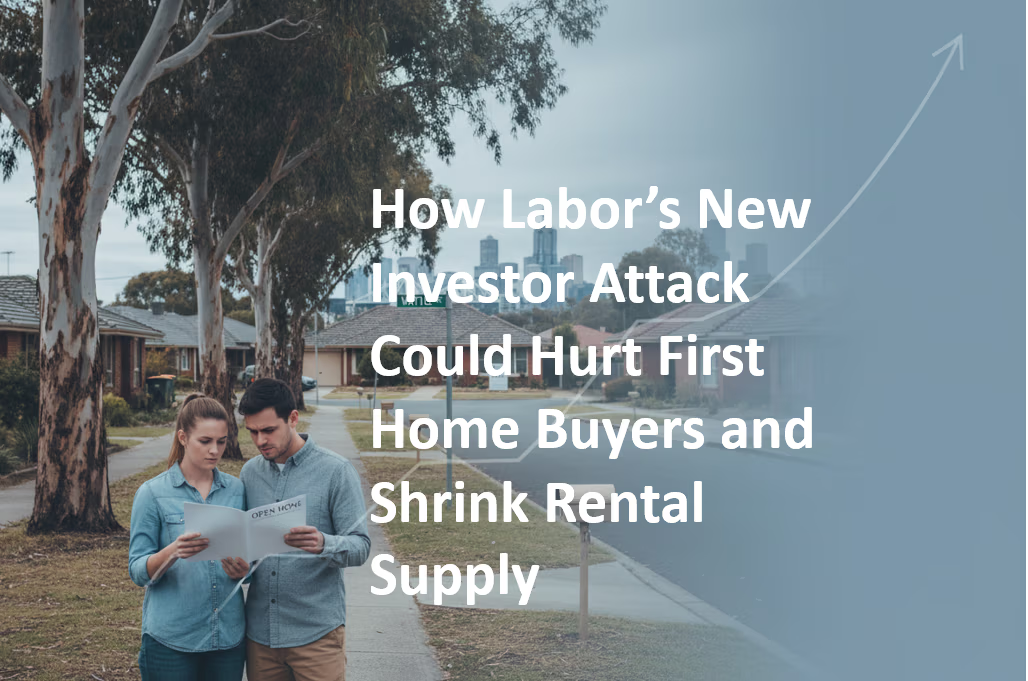
The policy story sounds simple — the housing reality isn’t
In the current election cycle, the Labor Party’s renewed focus on “cracking down” on property investors is being framed as a fairness measure: reduce investor demand, cool prices, and make it easier for first home buyers (FHBs) to get in.
We all should understand why that message lands. Housing affordability is real, and frustration is justified.
But the housing market is not a single market — it’s a connected system. When policy targets one part of that system (investors), the consequences don’t stay neatly contained. In practice, the biggest losers can be the very people the policy claims to help: first home buyers and renters.
Investors aren’t “extra demand” — they’re also the main source of rental supply
Australia’s rental market is overwhelmingly supplied by private investors, not governments. When investors are actively discouraged — through higher taxes, reduced deductibility, tighter compliance burdens, or rhetoric that signals they’re unwelcome — two things typically happen:
- Fewer new rental properties are added (especially in the “mum and dad investor” segment)
- Existing rentals are sold down as the risk/return equation deteriorates
The result is not theoretical. It shows up as:
- Lower vacancy rates
- Higher rents
- More competition for each available rental
- More pressure on social housing waitlists
If the policy environment makes investing structurally less attractive, the rental pool doesn’t magically refill itself. It contracts.
Why first home buyers can be harmed, not helped
The common assumption is: “If investors step back, first home buyers step in.” That can happen in isolated pockets. But at scale, the dynamics are more complicated.
1) Higher rents make saving a deposit harder
When rental supply tightens, rents rise. That directly reduces a first home buyer’s capacity to save.
For many aspiring buyers, the deposit is the bottleneck — not the desire to buy. A policy that increases rental stress can push the deposit goal further away, year after year.
2) The ‘rent trap’ worsens
As rents rise, households are forced to allocate more income to housing costs. That can:
- Reduce borrowing capacity (because living expenses are higher)
- Increase reliance on consumer debt
- Make it harder to demonstrate strong savings habits
In other words, a tighter rental market can trap people in renting longer — precisely the opposite of what affordability policy should do.
3) Reduced investor activity can reduce new construction
A large share of new apartment and townhouse projects rely on pre-sales, and investors often make up a meaningful portion of those buyers.
If investor demand is deliberately suppressed, developers face:

- Slower pre-sales
- Greater funding difficulty
- Higher project risk
That can mean fewer projects commence. Over time, that reduces overall housing supply — which is the real driver of long-run affordability.
If we want first home buyers to win, we need more homes. Policies that reduce the feasibility of building them are self-defeating.
The disincentive effect: when Australians stop believing effort leads to security
There’s a deeper issue here than market mechanics.
For decades, Australians have been encouraged to take responsibility for their future: work hard, save, invest, and aim to retire with dignity rather than relying solely on the Age Pension.
Property investment — especially a modest portfolio built over time — has been one of the most accessible pathways for ordinary households to do that.
When policy settings and political messaging treat investors as a problem to be punished, it sends a powerful signal:
- Long-term planning is risky
- Rules can change mid-game
- Building wealth is morally suspect
That creates a disincentive not just to invest in property, but to invest at all.
The emotional economics: hopelessness is a real economic variable
Economists often focus on incentives, but sentiment matters too. When people feel the system is stacked against them, they reduce effort and take fewer productive risks.
For aspiring retirees, the message becomes: “No matter what you do, you’ll end up dependent.”
That sense of hopelessness has consequences:
- Lower household investment
- Lower small-scale entrepreneurship
- Greater long-term reliance on government support
- More intergenerational resentment
If the goal is a resilient society, policy should expand pathways to self-reliance — not narrow them.
The pension problem: pushing more people toward government dependency
Australia’s Age Pension already represents a major fiscal commitment. If policy discourages private retirement provision, the long-term burden shifts back to the public balance sheet.

The irony is stark:
- Attack investors to “help affordability”
- Reduce rental supply and lift rents
- Make it harder for first home buyers to save
- Reduce private retirement security
- Increase future pension reliance
That is not a sustainable loop.
What would actually help first home buyers and renters?
If policymakers want to improve affordability without collateral damage, the focus should be on expanding supply and improving the functioning of the housing system.
Practical, economically coherent levers include:
- Faster planning approvals and zoning reform to unlock more buildable land and density where people want to live
- Infrastructure coordination so new housing is supported by transport, schools, and services
- Incentives for build-to-rent and institutional rental supply to diversify rental ownership beyond small investors
- Stable, predictable tax settings that reduce sovereign risk and encourage long-term investment
Most importantly, we need policy that recognises housing’s dual role:
- It’s a place to live
- It’s also a major component of household retirement planning
Treating one side as illegitimate destabilises the other.
The bottom line
The impulse to “take on investors” may be politically attractive, but economically it risks worsening the very outcomes Australians are struggling with: rental stress, delayed home ownership, and retirement insecurity.
First home buyers don’t just need lower prices — they need the ability to save, stable rents while they do, and a housing system that actually builds enough homes.
And Australians who want to retire with dignity need confidence that responsible, long-term investing won’t be punished for short-term political gain.







2 Responses
Hi
The long term consequences will be interesting